


Treehouses have transitioned from playful backyard constructions to valuable assets serving hospitality and educational purposes and ecological tourism. Developers and buyers who prioritize sustainability face significant challenges when constructing treehouses that maintain structural integrity without damaging the trees. Foundation Options for Treehouses Without Damaging Trees.
Construction professionals who source materials or distribute products need to understand the most effective foundation techniques to safeguard trees while maintaining structural durability to achieve top-tier sustainable construction results. This article examines various modern foundation solutions that preserve trees and evaluates their structural performance alongside environmental and commercial aspects.
Why Tree-Friendly Foundations Are Essential
Ecological Responsibility
Any damage to a tree’s bark, cambium layer, or root system results in:
- Compromise its stability
- Lead to disease and rot
- Shorten its lifespan
- Increase liability for property owners
Legal and Regulatory Compliance
Many regions now have:
- Tree protection ordinances
- Environmental impact assessments
- Restrictions on tree drilling or root disruption
Businesses that use non-invasive or minimally invasive foundations demonstrate environmental compliance and future readiness.
Customer Demand for Sustainability
Resort guests alongside homeowners and educational institutions expect sustainable building practices.
- Leave-no-trace designs
- Natural integration with landscapes
- Long-term health of trees and ecosystems
Overview: Types of Treehouse Foundation Systems
| Foundation Type | Tree Impact | Installation Complexity | Typical Applications |
|---|---|---|---|
| Ground-Based Posts | None | Moderate | All types of terrain |
| Treehouse Attachment Bolts | Minimal (1–2 per tree) | High | Large permanent structures |
| Floating or Suspended Systems | None | High | Wetlands, steep terrain |
| Hybrid (Posts + Trees) | Low | Moderate | Mid-sized multi-platform builds |
Let’s explore each option in detail.
Ground-Based Post Foundations
Description
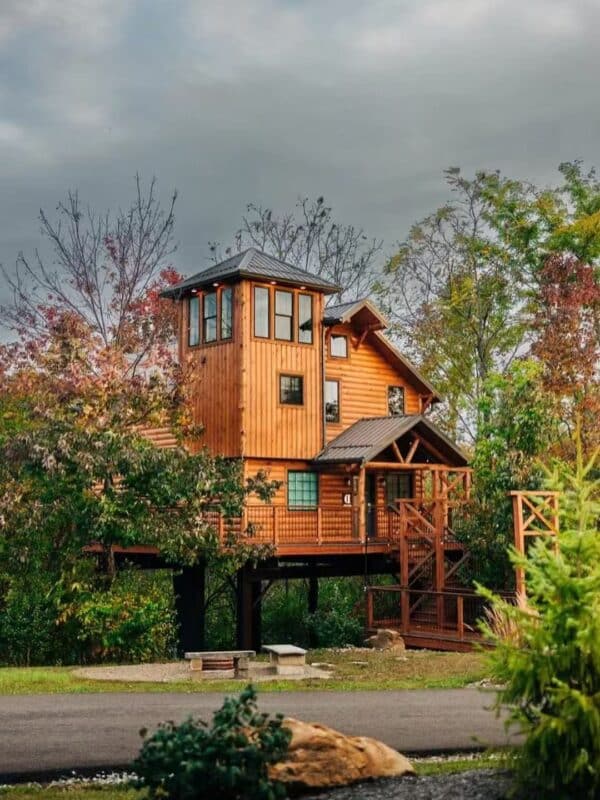
Vertical posts (wood, steel or concrete piers) form standalone foundations that start from the ground up while keeping clear of tree trunks and branches.
Benefits
- Zero damage to trees
- Supports heavier weight
- Ideal for commercial guesthouses or multi-level units
- Easier to obtain permits
Considerations
- Deep digging may be necessary so this foundation type should avoid areas with dense root systems.
- Must account for tree growth and movement
- Posts need durable, rot-resistant materials or coatings
Common Materials
- Pressure-treated timber
- Galvanized steel
- Concrete Sonotubes
Best For
- Resorts, glamping cabins, and ADA-compliant treehouses
- Regions where tree health remains a primary concern
Treehouse Attachment Bolts (TABs)
Description
These substantial bolts provide structural support while reducing the impact on trees. Platforms utilize TABs which attach directly into the heartwood to ensure minimal tree stress during installation.
Benefits
- The design of these anchors provides secure attachment while permitting trees to move naturally.
- The fastener requirement decreases with TABs compared to lag bolts.
- Long lifespan with proper maintenance
Considerations
- Requires arborist or licensed builder
- May still breach bark and cambium layer
- Not suitable for immature or unhealthy trees
- Must allow for tree growth and expansion
Best For
- Medium-to-large residential treehouses
- Hybrid tree/platform support designs

Floating or Suspended Foundations
Description
The use of cables or hanging systems attached to higher tree branches or external structures enables treehouses to “float” without requiring a rigid post structure underneath.
Benefits
- Zero ground or trunk impact
- This foundation type works well in wetlands and rocky terrain as well as on steep slopes.
- Visually stunning and immersive in nature
Considerations
- Requires highly skilled engineering
- As trees grow they can create changes in cable tension which affect the treehouse stability.
- May need annual adjustments and inspections
- Typically limited to lighter structures
Best For
- Observation platforms, hammocks, lightweight cabins
- Short-term guest units in delicate ecosystems
Hybrid Foundation Systems
Description
The support structure relies on ground posts while employing minimal tree fasteners to balance the load across both elements.
Benefits
- Reduces tree strain
- More flexible in uneven terrain
- Allows for expansion or multi-platform builds
Considerations
- Requires precise load calculation
- Higher initial engineering cost
- Initial tree intrusion remains limited to 1–2 bolts.
Best For
- Mid-sized resort or camp structures
- These inventive designs stretch across various trees and different ground surfaces.
Innovative Tree-Friendly Foundation Technologies in 2025
Helical Piers
- Screw-in steel shafts with minimal soil disruption
- Ideal for root-dense areas
- Reversible and removable (great for temporary builds)
Adjustable Post Anchors
- These anchors can adjust to accommodate ground movement as well as frost heave and tree growth.
- Compatible with modular and seasonal builds
Rubber Tree Collars (No Drill)
- Clamp-based non-invasive systems
- This system functions for the installation of light features such as balconies or stairs.
Foundation Recommendations by Project Type
| Project Type | Recommended Foundation |
|---|---|
| Backyard DIY Treehouse | Ground-based posts or hybrid |
| Resort Glamping Unit | Helical piers or ground posts |
| Lightweight Observation Deck | Suspended or tree-collar system |
| Multi-Tree Platform | Hybrid with TABs and floating deck |
| Temporary Event Structure | Adjustable piers or removable pads |
Evaluate site conditions through non-destructive methods to protect tree health.
Hire a Certified Arborist
- Check tree health and species suitability
- Identify root zones and safe distances
- Plan bolt placement if needed
Perform a Soil Survey
- Assess load-bearing capacity
- Determine drainage and frost line depth
- Choose appropriate pier or post materials
Use Non-Invasive Survey Tools
- Ground-penetrating radar to locate roots
- Laser mapping for elevation planning
- Drone imagery for design optimization
Selling Tree-Friendly Foundation Solutions to B2B Clients
Offer Pre-Engineered Systems
- Create catalog-ready kits with foundation recommendations
- Offer step-by-step manuals for local contractors
Bundle With Eco-Friendly Messaging
- Use FSC-certified wood
- Market as “leave-no-trace” construction
- Include environmental impact statement in proposals
Provide Consultation Services
- Help clients determine the best system
- Provide remote layout planning
- Offer local builder referrals
Conclusion
The decision to select a proper foundation stands as an essential step during treehouse construction. Businesses aiming to protect the environment and ensure safety while maintaining tree vitality find non-invasive foundation systems deliver environmental protection and commercial success.
By understanding modern foundation options you can ensure top quality construction of glamping units, residential hideaways, and educational structures while maintaining nature’s integrity.
Create partnerships with suppliers providing pre-engineered tree-safe systems to establish your catalog as the essential guide for sustainable outdoor design.
FAQ
Is it possible to construct a treehouse that doesn’t require attaching anything to the tree?
Yes. Treehouses can stand independently on ground-based post foundations or floating platforms without touching any trees.
Are TABs harmful to trees?
Professional installation of TABs ensures safety for trees while permitting their normal growth. Traditional lag bolts cause more damage to trees than TABs.
How long do tree-safe foundations last?
Ground posts and TABs will endure 20–30+ years when constructed from suitable materials with proper upkeep.
Yes these foundation systems are available for international shipping as pre-assembled kits.
Absolutely. Foundation components can be shipped as flat-packed units complete with assembly labels.
Can you provide expertise in layout planning and site design?
Yes. Our consultation packages and technical drawings are customized to fit the requirements of your specific project.
Contact Us
Let’s turn backyard dreams into stunning realities—together.
???? Email: info@treelofts.com
???? WhatsApp: +14582724313
???? Website: https://treelofts.com/
