


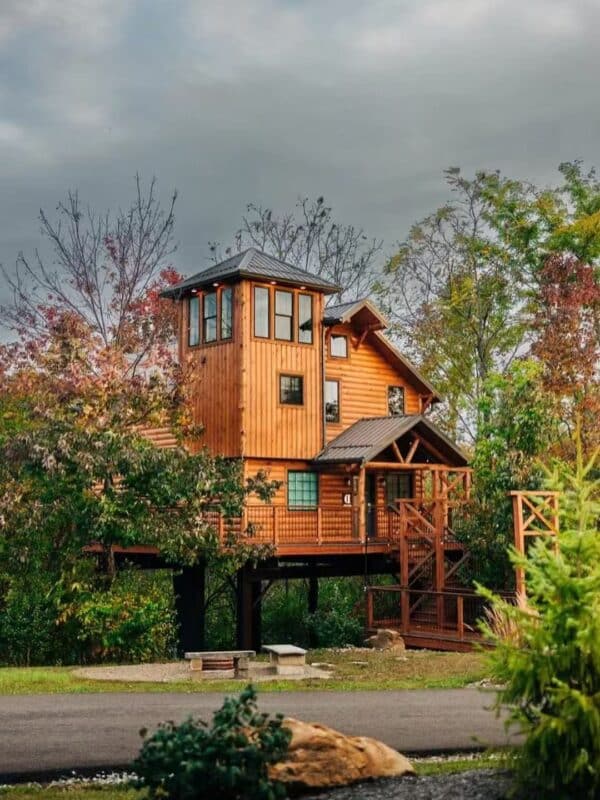
The role of treehouses has evolved from backyard playhouses into essential components for eco-resorts and permanent homes and various hospitality and wellness settings. Despite advancements in materials and hardware modern treehouses still depend fundamentally on one thing: the tree itself. What’s the Best Tree Species for Treehouse Support?
Selecting the appropriate tree species involves structural considerations which affect its load capacity as well as maintenance requirements while ensuring safety and longevity. Which tree species provides optimal support for treehouse construction?
This article examines the best tree species for platform support and explains how distributors and buyers can build elevated structures that combine safety with visual appeal.
Why Tree Species Matters in Treehouse Construction
A tree serves dual purposes as both support base and structural frame. A poor choice can lead to:
- Uneven load distribution
- Structural failure
- Long-term instability
- Costly retrofitting or relocation
Choosing the right tree ensures:
- Weight-bearing integrity
- Minimal long-term maintenance
- Healthy tree growth without harming structure
Qualities of an Ideal Tree for Treehouse Support
Before we dive into specific species, let’s outline the key traits of a suitable tree:
| Trait | Importance |
|---|---|
| Strong wood density | High load-bearing strength |
| Deep root system | Stability against wind and soil shift |
| Mature trunk (12″+ DBH) | Large diameter at breast height (DBH) for proper bolt placement |
| Straight, vertical growth | Ensures platform balance and ease of construction |
| Long lifespan | Reduces need for relocation or structural changes |
| Disease/pest resistance | Maintains strength and integrity over time |
The list ranks the best ten tree species for treehouse support.
1. Oak (Quercus spp. )
Why It’s Best:
Treehouses are built according to the exacting standards of oak trees.
- Dense, rot-resistant hardwood
- Excellent wind resistance
- Long lifespan (over 200 years)
- Deep roots and wide canopies
Recommended for: Permanent platforms, full-time homes, glamping treehouses
2. Maple (Acer spp. )
- Hard, stable wood
- Excellent vertical structure
- Reliable in cold climates
- Tolerates bracket installation well
**Note: Do not select soft or sugar maples that possess shallow root systems
3. Douglas Fir (Pseudotsuga menziesii)
- Strong and straight
- High tensile strength
- Found throughout the Pacific Northwest
- Good support tree when mature
**Best For: Douglas Fir serves as an ideal supporting tree for hybrid tree-ground structures and cabin construction in forested environments
4. Western Red Cedar (Thuja plicata)
- Naturally rot-resistant
- Aromatic and insect-repellent
- Can live 500+ years
**Consideration: When using softer wood select light structures or secure with multiple anchors

5. Hemlock (Tsuga spp. )
- High strength-to-weight ratio
- Excellent for multi-tree platforms
- Grows tall and evenly
**Drawback: Hemlock wood is susceptible to fungal infections so proper drainage at its base is essential.
6. Beech (Fagus grandifolia)
- Smooth bark and strong core
- Stable even in high wind areas
- Long-living hardwood
Caution: Sensitive bark—avoid over-penetration with fasteners
7. Ash (Fraxinus spp. )
- Extremely tough and flexible
- Handles high weight capacity
- Ash displays excellent performance characteristics throughout Midwest states and along the East Coast.
**Downside: Take precautions against emerald ash borer infestation by observing warning signs.
8. Elm (Ulmus spp. )
- Fast-growing with broad canopies
- Great for suspension-based or central-load designs
- Generally flexible, minimizing breakage under stress
Note: Dutch elm disease risk—choose disease-resistant cultivars
9. Sycamore (Platanus occidentalis)
- Massive trunks ideal for center-point treehouses
- Distinctive bark and aesthetic appeal
- Thrives near water
**Challenge: Extra sealing will be necessary because this material is sensitive to water exposure.
10. Linden / Basswood (Tilia spp. )
- Soft, yet surprisingly strong
- Good vertical structure
- Useful in multiple-tree clusters
**Limitation: Linden/Basswood trees cannot support very large treehouses unless ground support is provided.
Trees to Avoid for Treehouse Construction
| Tree Type | Reason to Avoid |
|---|---|
| Willow | Brittle wood, shallow roots |
| Poplar | Soft, weak under weight |
| Birch | Susceptible to disease and pests |
| Eucalyptus | Excessively oily, prone to cracking |
| Fruit Trees | Too small and delicate |
Always avoid:
- Trees with rot or fungus
- Leaning or imbalanced trunks
- Trees in saturated or eroding soil zones
What Distributors and Developers Need to Know
Site Evaluation Services
Offer a tree inspection add-on before installation:
- Certified arborist evaluation
- Soil condition analysis
- Root system assessment
- Long-term growth projection

Engineering Recommendations
Encourage clients to:
- Use Treehouse Attachment Bolts (TABs)
- Space anchors evenly across load points
- Large builds require reinforcement through the use of floating brackets or hybrid post supports.
- Avoid direct nailing to bark or limbs
Marketing Strategy
When promoting treehouse kits:
- Highlight compatibility with specific tree species
- Display images of platforms secured to oak trees and other species like maples.
- Include a “Tree Suitability Checklist” within sales materials for customers.
- It is important to teach buyers about the growth patterns of trees and options for future expansion of their treehouse.
Best Practices for Long-Term Tree Health
| Tip | Benefit |
|---|---|
| Use minimal anchor points | Preserves bark and vascular tissue |
| Avoid encircling bark with chains | Prevents girdling and tree death |
| Allow for sway and growth | Prevents stress fractures |
| Conduct annual arborist checkups | Maintains safety and identifies disease early |
Conclusion
The foundation of every successful treehouse project lies in selecting the appropriate tree species. Building either a tiny retreat or a complete rental space requires support from a tree that exhibits strength and good health while being correctly chosen to ensure safety and durability together with peace of mind.
Distributors, builders and commercial buyers who understand and recommend suitable tree species create successful projects and establish trust with their clients.
Our team provides site consultations and custom treehouse kit solutions based on tree species selection. Our team offers site consultation, kit customization and commercial pricing for treehouse designs. **
???? info@treelofts.com
???? [+1 503 793 2928]()
???? https://treelofts.com/
FAQ
Treehouses require trees with a minimum diameter of 12 inches at breast height for adequate support.
Treehouses require trees with a minimum diameter of 12 inches at breast height (DBH) according to general guidelines although larger trees provide greater support.
Multi-tree systems are feasible and help balance the load across several trees.
Multi-tree systems are commonly used because they provide balanced weight distribution.
Do trees get damaged by treehouses?
Trees remain unharmed from treehouses when professionals implement both TABs and floating brackets. Trees will continue to grow and adapt.
Is it possible to build treehouses using softwood trees such as pine and spruce?
Only with proper engineering and lighter structures. Reinforce with ground supports when necessary.
Does Treelofts offer species-specific treehouse kits?
Yes. Our services include designing custom arrangements which consider your site’s specific trees and we create hybrid solutions for different support necessities.
Contact Us
Let’s turn backyard dreams into stunning realities—together.
???? Email: info@treelofts.com
???? Phone: +1 503 793 2928
???? Website: https://treelofts.com/
