


Tree houses are not an exception; using Eco-Friendly Tree Houses materials in building is a rising trend in a society more and more preoccupied with sustainability and environmental conscience. Living in tune with the surroundings appeals, thus a tree home can become a haven that improves your relationship with the surroundings while following green building ideas. Whether your passion is tree houses, you are a homeowner trying to create a personal retreat, or you are a supplier trying to satisfy demand for Eco-Friendly Tree Houses buildings—knowing the appropriate materials to employ is very vital.
We shall explore the realm of sustainable resources for building a tree house right here on this blog. Selecting appropriate materials will help you to guarantee that your tree home is made to last and ecologically benign. Apart from reducing the environmental impact, sustainable building methods enhance energy economy, durability, and general aesthetic appeal. This guide will help you grasp your choices, from materials to techniques, thereby enabling a really green outdoor refuge whether you’re thinking about building or upgrading a tree home. Read on to learn how Eco-Friendly Tree Houses building materials might enable you to realize your ideal tree house.

Value of Sustainable Materials for Tree House Building
Constructing a tree house offers a chance to mix environmental responsibility, design, and utility. In terms of environmental effect and long-term structural integrity as well as other advantages, sustainable materials offer. The availability and appeal of Eco-Friendly Tree Houses materials have exploded as the building sector develops, therefore facilitating prudent decisions. But just why is it so crucial for your tree home project to employ sustainable materials?
Conventional building materials including plastics, cement, and non-renewable timber as well as polymers can have major negative environmental consequences. For instance, the taking of lumber from unsustainable sources fuels deforestation and a loss of biodiversity. Conversely, sustainable materials come from recycled or renewable resources, therefore helping to protect the priceless ecosystems of the globe. Choosing environmentally suitable substitutes will help your tree house’s carbon footprint to be actively lowered.
Usually, sustainable materials—which are resource-conserving—are grown or manufactured with little disturbance of the surroundings. For instance, carefully chosen wood from certified forests guarantees that ecosystems stay balanced and that trees are replaced. This is unlike materials that exhaust natural resources, therefore exposing ecosystems to collapse. By using sustainable resources, you can help to guarantee a better future by avoiding aggravation of resource depletion.
Long-Term longevity and Low care: Many sustainable materials demand less care and show superior longevity than conventional choices. For example, some forms of treated wood and recycled metals are more resistant to the elements, therefore lowering the need for regular repairs and replacements. This means fewer resources being used over time, hence your tree house is a sustainable construction for many years to come.
By controlling temperature and hence reducing heating or cooling needs, sustainable building materials help to increase energy efficiency. Natural insulating materials like hemp or cork, for instance, can help to lower the demand for synthetic temperature control, therefore lowering energy use. Additionally, low embodied energy makes sustainable materials less energy is needed to create and transport them.
Natural beauty that fits perfectly with outdoor surroundings is sometimes provided by aesthetic appeal and integration with nature sustainable materials. Using repurposed wood, bamboo, or natural stone will improve the appearance of the tree home and help to maintain the harmony of the surroundings. These products provide a peaceful haven that is not only aesthetically pleasing but also ecologically responsible, therefore improving the whole quality of life in or near nature.
Using sustainable materials in tree home building will help the surroundings as well as your living area. Here are some of the most sustainable materials available that would improve your tree house design and fit with environmental values.
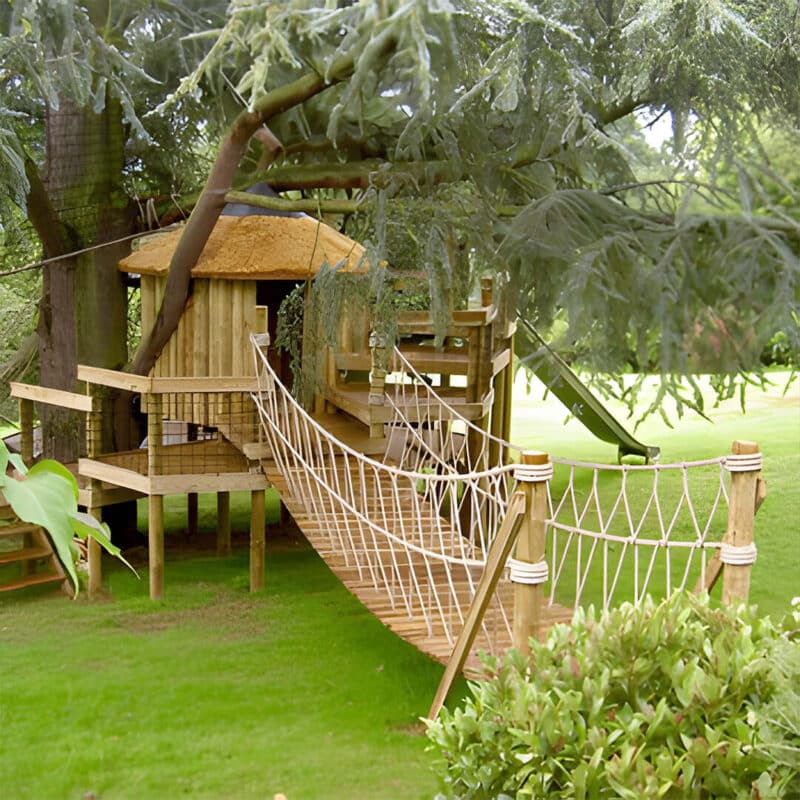
Greatest Sustainable Materials for Building Tree Houses
Building an Eco-Friendly Tree Houses starts mostly with selecting appropriate materials. These are some of the most sustainable materials to think about; they have uses and benefits unique from one another.
Bamboo: The Eco-friendly Construction Material
Among the most adaptable and Eco-Friendly Tree Houses materials available is bamboo. Often up to several feet each day, bamboo is a fast-growing, extremely renewable material. It can be applied to flooring, structural supports, railings, even wall panels. Bamboo is a great choice for outdoor constructions like tree houses not just because it is robust and resilient but also naturally resistant to pests.
Benefits of bamboo:
- Given fast development, it is a quite renewable resource.
- More flexible and stronger than several hardwoods.
- Biodegradable and recyclable or reusable.
- Lightweight allows handling and transportation of it more easily.
Modern tree house designs would find bamboo to be a perfect material because of its strength, adaptability, and visual appeal. Whether your tree home is simple or more complex multi-level construction, bamboo can be rather important in producing a lovely, Eco-Friendly Tree Houses platform.
Reclaimed Wood: Stylish and Ecological
Especially for those looking for a rustic, natural design for their tree home, reclaimed wood is among the most often used sustainable materials. Repurposed for new building, this timber comes from existing buildings, barns, or shipping pallets. This is a sustainable alternative since it not only lessens the demand for fresh timber but also helps keep wood out of landfills.
Advantages of reclaimed wood include:
- Gives your tree house particular appeal and uniqueness.
- Keeps items out of landfills and helps to cut waste.
- Usually local, this reduces transportation emissions.
- Premium wood with shown longevity.
For flooring, walls in a tree house, even furniture, reclaimed wood is ideal. The worn look of reclaimed wood offers personality and warmth, therefore harmonizing with the surroundings naturally.
Cork: Natural Green Edge Insulation
Natural, renewable cork comes from the bark of cork oak trees. Excellent thermal characteristics and moisture resistance of this adaptable material make it frequently employed as insulation. Environmentally aware tree house builders will find cork to be a great choice because it is lightweight, strong, and biodegradable.
Cork has certain advantages:
- Natural insulator, so lowering the demand for further cooling or heating.
- Lightweight and simple to manage during building.
- Recyclable and biodegradable.
- Collected without damaging the tree since the bark heals.
Cork can be flooring, insulation, and even decorative accents. Tree houses—especially those meant for passive climate control—find it appealing because of its natural texture and environmental friendliness.
Hempcrete: Strong and Eco-friendly Insulation
Made from hemp plant fibres, hempcrete is a green substitute for conventional concrete. Highly effective in insulating against heat and cold, this non-toxic, biodegradable substance is also ideal for building energy-efficient tree homes that are well-insulated without depending on destructive materials.
Advantages of hempcrete:
- Offers great insulating value, so lowering energy use.
- Designed from the hemp plant, non-toxic and sustainable.
- Strong and immune to mildew, mold, and pests.
- Easy to operate and lightweight.
Using hempcrete for flooring or walls gives a natural, sustainable choice for building a cosy, insulated tree house. Strong insulating qualities of hempcrete help to lower the demand for synthetic climate control.
Durable and Long-Lasting Recycled Metal
Custom furniture, tree house construction reinforcement, or even design accent creation can all be accomplished with recycled metal—such as steel or aluminum. By using recycled metal, one less virgin material has to be produced and metal doesn’t wind up in landfills. Over time, metal takes minimal maintenance and is quite durable.
Advantage of recycled metal:
- Low-maintenance, highly durable, weather-resistant.
- Reversible at the conclusion of their lifetime.
- Robust and capable of supporting big, weighty loads.
- Lessens demand for metal manufacture and mining.
For structural components like beams or columns, recycled metal performs effectively, thereby assuring the tree house stays robust and sturdy. Roofing, gutters, and other parts benefiting from its lifetime can also be made from it.
Natural and Eco-Friendly Green Roof Systems
Planting vegetation over your tree house’s roof creates a living ecosystem with many environmental advantages known as a green roof. Eco-aware tree house builders would find great value in green roofs since they naturally insulate, lower stormwater runoff, and provide habitats for wildlife.
Advantages of green rooftops:
- Gives natural insulation, so improving energy efficiency.
- Helps stop flooding and lessens stormwater runoff.
- Provides habitats for birds, insects, and other animals therefore fostering biodiversity.
- Improves the look of your tree home with surrounding natural vegetation.
The top of your tree house can become a rich, living area that fits perfectly with the surroundings by means of green rooftops. Additionally beneficial for the environment are they serve to lower the urban heat island effect and support biodiversity.
Combining Sustainable Materials for Best Effect
Not only should one use sustainable materials but also mix them to maximize their advantages when building a tree house. These ideas will help you to properly apply Eco-Friendly Tree Houses materials in your tree home construction:
Think about the environment.
The local temperature will affect the materials you decide upon. For colder climates, for instance, cork or hempcrete could be perfect; for warmer climates, bamboo and salvaged wood could be more suitable. To maximize comfort and energy economy, always match your chosen materials to the particular conditions of your surroundings.
Prioritize low maintenance and durability.
Choose items with little upkeep and durability. Built to last, sustainable elements such recycled aluminum, bamboo, and repurposed wood will eventually help to save resources. Stressing durability will help you to lower the demand for regular repairs and replacements, so saving time and energy.
Combining modern and natural materials is great.
A tree home doesn’t have to be totally rustic or modern; rather, you can combine natural materials with modern, ecological solutions to get the design and purpose you want. For structural reinforcement to guarantee the tree house stands strong for years, repurposed metal can be used; mixing reused wood with a green roof produces a combination of organic beauty and environmental benefits.
Design with Mindful Energy Efficiency
Your tree house’s energy needs will be much lowered by including natural insulating materials such as cork, hempcrete, and even green rooftops. By encouraging airflow and hence lowering heat retention, materials like bamboo and reclaimed wood also offer great passive cooling in warmer areas.
Give Local Materials Top Priority.
Use locally produced materials wherever at all feasible. This advances local businesses and lowers transportation emissions. Further improving the sustainability of your tree home is the fact that locally produced materials often fit your particular climate and surroundings.

Conclusion
Constructing a tree house offers a special chance to design an outdoor haven reflecting your tastes and values. Using sustainable materials helps you not only reduce your environmental effect but also create a strong, energy-efficient, aesthetically beautiful building that accentuates the natural beauty of your surrounds. Every material you choose—bamboo, salvaged wood, cork, hempcrete, or recycled metal—brings unique advantages that can improve your tree house.
Think about how each element interacts to produce a harmonic, Eco-Friendly Tree Houses setting your family will be able to enjoy for years to come as you start this fascinating adventure. Investing in sustainable materials not only helps the earth but also guarantees that your tree house stays a secure, comfortable haven. It’s time now to begin designing your Eco-Friendly Tree Houses and realize your dream!
Frequently Asked Questions
Which Eco-Friendly Tree Houses materials would be best for tree homes?
Bamboo, repurposed wood, cork, hempcrete, recycled metal, and green roof systems rank highest among the Eco-Friendly Tree Houses materials. Every one of these components is durable, reusable, and helps your tree house have less of an impact on the surroundings.
For my tree house, which sustainable material would be best?
Think through elements including your local climate, preferred look, and functional needs. For structural elements, bamboo is a strong, flexible alternative; cork and hempcrete, for instance, offer great insulating value. Selecting locally produced products will also help to reduce transportation emissions.
Are Eco-Friendly Tree Houses materials more costly than more conventional ones?
Although their initial cost may be more, eco-friendly materials frequently save money over time because of their durability, energy economy, and low maintenance requirements. Furthermore, as demand rises, many sustainable materials are increasingly more reasonably priced.
For all facets of my tree house, can I build using sustainable materials?
Sure! Every feature of your tree house—including walls, flooring, roofing, insulation, and structural support—can be built from sustainable materials. The secret is to combine elements depending on your environmental objectives and design taste.
Will a sustainable materials tree home last?
Right! Often more lasting than traditional choices are sustainable materials, including recycled metal, bamboo, and reclaimed wood. A tree house constructed of environmentally acceptable materials can last for many years with appropriate maintenance, therefore lowering the demand for regular repairs or replacements.
Understanding and using sustainable materials for your tree house project will help you design a beautiful, useful, environmentally responsible space that will last.
